1. Back on the slopes in seven weeks after a serious shoulder
A keen skier came off badly on the mountain, fracturing the top of the upper arm bone and fully dislocating the shoulder — which then stayed out of joint for five hours before it could be put back under anaesthetic. It’s the kind of combined injury that usually means three to four months before demanding sport.
Treatment began just six days later, while the arm was still in a sling. The thinking was simple: the early, inflamed phase is the window when bone and tissue are most ready to respond, so EMTT was started straight away to support the bone, with focused shockwave for the soft-tissue damage from the dislocation.
The patient didn’t return to skiing until the treating orthopaedic surgeon independently confirmed the bone had healed on imaging — at four weeks. By seven weeks they were back off-piste, and two years on the shoulder remains pain-free with full movement.
*The biology wasn’t skipped — it was given every chance to move quickly.*
2. Avoiding Achilles surgery as a Hyrox competitor
*Meta: Insertional Achilles pain and a Haglund deformity treated without surgery, using focused shockwave, EMTT and careful loading.*
A competitive endurance athlete in their mid-40s had pain at the back of the heel where the Achilles tendon meets the bone — an insertional Achilles tendinopathy with a Haglund deformity (a bony prominence that aggravates the tendon). They’d already tried radial shockwave elsewhere with no improvement, which is a common story: that gentler form simply doesn’t reach the deep insertion point.
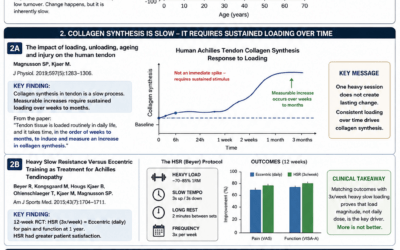
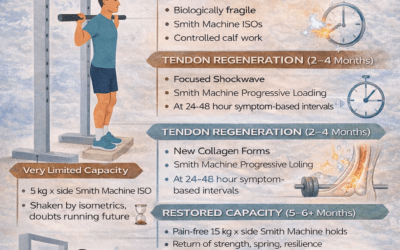
Focused shockwave does. Over eight sessions, paired with EMTT and a slow, heavy loading programme built around 45-second holds twice a week, the picture changed. The loading was deliberately patient — heavy enough to rebuild the tendon, slow enough to respect how long new blood vessels and collagen actually take to form.
The athlete returned to competition pain-free and placed first in their age category at an international event. A follow-up scan over a year later showed only mild residual change — real, measurable structural improvement on imaging.
It’s also the first of six patients at the clinic who were heading for Haglund surgery and avoided it. Worth knowing, given that operation can mean weeks non-weight-bearing and a long, uncertain road back to sport.
3. Six years, one casual question, and a podium finish
This one spans six years. A masters middle-distance runner first came in during the 2020 lockdown with hamstring and glute pain that felt more nerve-related than muscular. Focused shockwave and EMTT settled it.
Then, mid-session, almost in passing: *“While I’m here — can you check my foot?”* A low-energy shockwave pulse to the area produced an immediate, sharp pain response. That reaction pointed to a rare stress fracture — already in the early healing phase. He’d been about to race the very next day; doing so could have displaced it and ended his running. He didn’t race.
Imaging was hard to access through the pandemic, so continuity of care mattered enormously. Years later, when a Haglund deformity appeared and surgery was suggested, the same focused-shockwave-plus-EMTT-plus-loading approach kept him off the operating table again.
He’s since gone on to a medal at a major European masters championship and a national age-group record. A reminder that the most useful moment in a long clinical relationship can be an unplanned one.
4. Regaining a paralysed arm: a neurosurgeon-led recovery
*Meta: After complex neck surgery left one arm fully paralysed, a multidisciplinary shockwave protocol supported an unexpected recovery.*
This patient was under the care of a consultant neurosurgeon and underwent complex multi-level neck surgery. The procedure disturbed nerve fibres that were still working, and they woke with complete motor paralysis of the left arm and absent reflexes — worse than before the operation. The prognosis given was permanent disability.
The neurosurgeon had actually requested focused shockwave *before* surgery, delivered twice weekly over several months along the affected nerve pathways. After the post-operative setback, a structured, neurosurgeon-directed multimodal recovery programme continued.
This is a case at the edge of what shockwave is conventionally used for, which is exactly why it was managed in close partnership with the surgical team rather than independently. It’s a good illustration of working within your scope while contributing something genuine to a wider clinical effort — and of what careful collaboration can achieve when the starting point looks bleak.
*Shared here with consent for the named surgical collaboration.*
5. Told her running career was over — then a championship personal best
An international-standard runner came in with severe patellar tendinosis — degeneration of the tendon below the kneecap, one of the hardest tendon problems to treat. She’d already had two steroid injections, prolotherapy and a full eccentric exercise programme, none of which helped. The orthopaedic view was that surgery was the only option left, and likely to fail. Her career was considered finished.
She was the clinic’s very first focused shockwave patient. The reasoning behind the switch: a degenerative tendon can’t be *injected* into healing — it needs a biological reason to rebuild itself, which is what focused shockwave provides. Radial shockwave was added from the second session.
Twelve months later — one year to the day from her first session — she ran a 5km personal best at a national championship road race. She’s still competing, with no further injections needed.
Sometimes the case that changes how a clinic practises is the first one that proves a point.
6. Returning to elite running after a difficult birth
*Meta: A sensitive postpartum recovery handled within a multidisciplinary team, leading back to international competition.*
An elite middle-distance runner had a long and complicated birth that left her with significant pelvic and soft-tissue injury, unable to sit and struggling to walk. A secondary infection meant readmission to hospital. The early phase wasn’t about treatment at the clinic at all — it was about recognising when to step back, advise imaging and let hospital care lead.
Once she’d stabilised, care moved into a proper team effort alongside a pelvic health physiotherapist, who identified pelvic floor and pelvic joint problems. Focused shockwave and EMTT were then used to support pelvic floor recovery.
The return to running was gradual and sensibly paced — pulling back at the first sign the body wasn’t ready, rather than pushing through. In time she made a full return to international competition.
It’s an honest example of women’s health being an emerging area for these therapies, and of recovery that depended on patience and good teamwork as much as any single treatment.
7. Preparing tissue for stem cell treatment after a wrist injury
After fracturing and dislocating a wrist, this patient had surgery to fix it with metalwork, healed well, and had the metalwork removed a couple of months later. What makes the case interesting is what came next: focused shockwave and EMTT used as a *priming* step in the week before a stem cell injection.
The idea is mechanistic but elegant. Shockwave appears to switch on a “homing” signal in the target tissue that helps draw stem cells to exactly the spot that needs repair. So the sequence is: stabilise the injury surgically first, then optimise the biology — orthopaedics and regenerative medicine working in order rather than in competition.
This is a live, leading-edge case, managed in partnership with the regenerative-medicine team and with the patient using supportive measures of their own at home. It’s shared as a genuine work-in-progress rather than a finished result — a look at where this kind of integrated practice is heading.
Back in the game: chronic groin pain in an elite
An elite footballer had been out of competition for six months with osteitis pubis and adductor groin pain — pain at the pubic joint and where the groin muscles attach. He’d already had a groin operation years earlier, plus six months of structured rehab and steroid injections, none of which resolved it. By any measure, a stubborn, refractory case.
The approach matched the treatment to the tissue. Three different problems, three tools: EMTT for the bone swelling at the pubic joint, focused shockwave for the deeper tendon and cartilage damage, and radial shockwave for the surrounding muscle. Six sessions across four weeks.
By week four he was doing football-specific work, pain-free, with his confidence back — and that last point matters as much as the pain itself. Returning to elite sport after six months out is as much psychological as physical. He’s now playing and building back to full competition.
A serious hamstring tear that didn’t need the operating
A former professional footballer suffered a severe, full-thickness tear of the hamstring during a match, with the muscle pulled back several centimetres and extensive surrounding damage on the scan. On the standard classifications, this is firmly surgical territory and predicts a long lay-off.
The decision here was unusual: start focused shockwave straight away, within days of the injury — earlier than any published trial covers. The rationale was mechanistic, using shockwave to amplify the body’s own repair response at the site where tendon meets muscle, and to organise healthy new tissue as it forms.
At the ten-week orthopaedic review, the tendon was already healing and surgery was judged unnecessary. He completed football-specific rehab and returned to competitive play — going on to help his team win their league.
A clear case of practising at the edge of the evidence, guided by mechanism, while keeping the surgical team involved at the key decision point.
—–
## 10. Nine years on, still running internationally — without surgery
*Meta: A 4cm gap in the hamstring tendon, a surgical recommendation declined, and a long, durable recovery.*
An international marathon runner was found to have chronic proximal hamstring tendinopathy with a 4cm gap where the tendon attaches to the sitting bone. That’s a finding that would normally head straight to surgery. She declined.
Instead, the plan was weekly radial shockwave over six months — and the key word there is *six months*. Chronic tendon problems don’t reward impatience; they reward consistency over time. She returned to international competition, including hill and mountain running.
The most powerful part of this case is the follow-up: nine years later, no recurrence. Long-term outcome data like that is about the strongest evidence a clinic can point to — not just that something worked, but that it kept working.
—–
## 11. From multiple chronic injuries to international gold
*Meta: A masters sprinter with several long-standing tendon problems, supported back to major international success.*
A masters sprinter arrived with three chronic problems at once — Achilles tendinopathy, plantar fasciitis and recurring calf strains. All long-standing, all the kind of thing that quietly ends sprinting careers.
The work was multi-modal, using the clinic’s shockwave and EMTT programme alongside the athlete’s own strength, conditioning and rehabilitation. And that partnership is the real story: within about three years she went from a multi-site chronic presentation to winning gold at a major international masters championship, with record-breaking performances along the way.
The clinical credit here is shared, openly and deliberately, with the athlete herself — her knowledge of her own body, her discipline in rehab, and her commitment to the work. The clinic’s role was to be one part of a wider performance team, not the whole of it.
That’s a theme across many of these stories: the best outcomes come from long-term relationships and trust built over years, not single sessions.
# Patient Case Stories — Blog Drafts
### Helen How Clinic, Edinburgh
*A set of blog-ready summaries drawn from the clinic’s anonymised case archive. Each one is written for a general reader rather than a clinical audience: plain language, the human story, and a light explanation of the treatment used.*
—–
## A note before you publish
These read well, but a few practical points for public use:
– **Consent for publication.** Anonymising a case for CPD is not the same as a patient agreeing to have their story on a public blog. It’s worth getting a quick explicit sign-off for blog use, particularly for the postpartum case (Case 6) and any patient who’s identifiable from their results.
– **Identifiability.** I’ve generalised the most pinpointing details (exact race times, specific medals and records, precise dates) so the athletes aren’t easily traceable. The originals are in your archive if you’d rather restore any.
– **Claims.** I’ve kept everything to “this is what happened for this patient” rather than “this is what shockwave will do for you,” which keeps the tone honest and within GOsC / ASA advertising guidance. I’d avoid editing them back toward guaranteed-outcome language.
**Two terms used throughout (handy to define once on your site or link to a glossary):**
– **Focused shockwave (ESWT)** — high-energy acoustic waves delivered to a precise depth, used to kick-start healing in stubborn tendon, bone and soft-tissue problems. *Radial* shockwave is a gentler, more superficial version; the two do different jobs.
– **EMTT (magnetotransduction therapy)** — a magnetic-field therapy that works deeper in bone and tissue, often paired with shockwave.
—–
## 1. Back on the slopes in seven weeks after a serious shoulder injury
*Meta: How focused shockwave and EMTT helped a skier recover from a fractured, dislocated shoulder far faster than expected.*
A keen skier came off badly on the mountain, fracturing the top of the upper arm bone and fully dislocating the shoulder — which then stayed out of joint for five hours before it could be put back under anaesthetic. It’s the kind of combined injury that usually means three to four months before demanding sport.
Treatment began just six days later, while the arm was still in a sling. The thinking was simple: the early, inflamed phase is the window when bone and tissue are most ready to respond, so EMTT was started straight away to support the bone, with focused shockwave for the soft-tissue damage from the dislocation.
The patient didn’t return to skiing until the treating orthopaedic surgeon independently confirmed the bone had healed on imaging — at four weeks. By seven weeks they were back off-piste, and two years on the shoulder remains pain-free with full movement.
*The biology wasn’t skipped — it was given every chance to move quickly.*
—–
## 2. Avoiding Achilles surgery as a Hyrox competitor
*Meta: Insertional Achilles pain and a Haglund deformity treated without surgery, using focused shockwave, EMTT and careful loading.*
A competitive endurance athlete in their mid-40s had pain at the back of the heel where the Achilles tendon meets the bone — an insertional Achilles tendinopathy with a Haglund deformity (a bony prominence that aggravates the tendon). They’d already tried radial shockwave elsewhere with no improvement, which is a common story: that gentler form simply doesn’t reach the deep insertion point.
Focused shockwave does. Over eight sessions, paired with EMTT and a slow, heavy loading programme built around 45-second holds twice a week, the picture changed. The loading was deliberately patient — heavy enough to rebuild the tendon, slow enough to respect how long new blood vessels and collagen actually take to form.
The athlete returned to competition pain-free and placed first in their age category at an international event. A follow-up scan over a year later showed only mild residual change — real, measurable structural improvement on imaging.
It’s also the first of six patients at the clinic who were heading for Haglund surgery and avoided it. Worth knowing, given that operation can mean weeks non-weight-bearing and a long, uncertain road back to sport.
—–
## 3. Six years, one casual question, and a podium finish
*Meta: A masters runner’s long relationship with the clinic — including a chance discovery that may have saved his career.*
This one spans six years. A masters middle-distance runner first came in during the 2020 lockdown with hamstring and glute pain that felt more nerve-related than muscular. Focused shockwave and EMTT settled it.
Then, mid-session, almost in passing: *“While I’m here — can you check my foot?”* A low-energy shockwave pulse to the area produced an immediate, sharp pain response. That reaction pointed to a rare stress fracture — already in the early healing phase. He’d been about to race the very next day; doing so could have displaced it and ended his running. He didn’t race.
Imaging was hard to access through the pandemic, so continuity of care mattered enormously. Years later, when a Haglund deformity appeared and surgery was suggested, the same focused-shockwave-plus-EMTT-plus-loading approach kept him off the operating table again.
He’s since gone on to a medal at a major European masters championship and a national age-group record. A reminder that the most useful moment in a long clinical relationship can be an unplanned one.
—–
## 4. Regaining a paralysed arm: a neurosurgeon-led recovery
*Meta: After complex neck surgery left one arm fully paralysed, a multidisciplinary shockwave protocol supported an unexpected recovery.*
This patient was under the care of a consultant neurosurgeon and underwent complex multi-level neck surgery. The procedure disturbed nerve fibres that were still working, and they woke with complete motor paralysis of the left arm and absent reflexes — worse than before the operation. The prognosis given was permanent disability.
The neurosurgeon had actually requested focused shockwave *before* surgery, delivered twice weekly over several months along the affected nerve pathways. After the post-operative setback, a structured, neurosurgeon-directed multimodal recovery programme continued.
This is a case at the edge of what shockwave is conventionally used for, which is exactly why it was managed in close partnership with the surgical team rather than independently. It’s a good illustration of working within your scope while contributing something genuine to a wider clinical effort — and of what careful collaboration can achieve when the starting point looks bleak.
*Shared here with consent for the named surgical collaboration.*
—–
## 5. Told her running career was over — then a championship personal best
*Meta: Severe patellar tendon damage, two failed injection courses, surgery the only option left — and a different path that worked.*
An international-standard runner came in with severe patellar tendinosis — degeneration of the tendon below the kneecap, one of the hardest tendon problems to treat. She’d already had two steroid injections, prolotherapy and a full eccentric exercise programme, none of which helped. The orthopaedic view was that surgery was the only option left, and likely to fail. Her career was considered finished.
She was the clinic’s very first focused shockwave patient. The reasoning behind the switch: a degenerative tendon can’t be *injected* into healing — it needs a biological reason to rebuild itself, which is what focused shockwave provides. Radial shockwave was added from the second session.
Twelve months later — one year to the day from her first session — she ran a 5km personal best at a national championship road race. She’s still competing, with no further injections needed.
Sometimes the case that changes how a clinic practises is the first one that proves a point.
—–
## 6. Returning to elite running after a difficult birth
*Meta: A sensitive postpartum recovery handled within a multidisciplinary team, leading back to international competition.*
*(Please confirm explicit consent before publishing — this is an intimate health story.)*
An elite middle-distance runner had a long and complicated birth that left her with significant pelvic and soft-tissue injury, unable to sit and struggling to walk. A secondary infection meant readmission to hospital. The early phase wasn’t about treatment at the clinic at all — it was about recognising when to step back, advise imaging and let hospital care lead.
Once she’d stabilised, care moved into a proper team effort alongside a pelvic health physiotherapist, who identified pelvic floor and pelvic joint problems. Focused shockwave and EMTT were then used to support pelvic floor recovery.
The return to running was gradual and sensibly paced — pulling back at the first sign the body wasn’t ready, rather than pushing through. In time she made a full return to international competition.
It’s an honest example of women’s health being an emerging area for these therapies, and of recovery that depended on patience and good teamwork as much as any single treatment.
—–
## 7. Preparing tissue for stem cell treatment after a wrist injury
*Meta: An active case using focused shockwave and EMTT to “prime” a healing wrist ahead of stem cell therapy.*
After fracturing and dislocating a wrist, this patient had surgery to fix it with metalwork, healed well, and had the metalwork removed a couple of months later. What makes the case interesting is what came next: focused shockwave and EMTT used as a *priming* step in the week before a stem cell injection.
The idea is mechanistic but elegant. Shockwave appears to switch on a “homing” signal in the target tissue that helps draw stem cells to exactly the spot that needs repair. So the sequence is: stabilise the injury surgically first, then optimise the biology — orthopaedics and regenerative medicine working in order rather than in competition.
This is a live, leading-edge case, managed in partnership with the regenerative-medicine team and with the patient using supportive measures of their own at home. It’s shared as a genuine work-in-progress rather than a finished result — a look at where this kind of integrated practice is heading.
—–
## 8. Back in the game: chronic groin pain in an elite footballer
*Meta: Refractory osteitis pubis and adductor groin pain resolved in four weeks with a three-modality approach.*
An elite footballer had been out of competition for six months with osteitis pubis and adductor groin pain — pain at the pubic joint and where the groin muscles attach. He’d already had a groin operation years earlier, plus six months of structured rehab and steroid injections, none of which resolved it. By any measure, a stubborn, refractory case.
The approach matched the treatment to the tissue. Three different problems, three tools: EMTT for the bone swelling at the pubic joint, focused shockwave for the deeper tendon and cartilage damage, and radial shockwave for the surrounding muscle. Six sessions across four weeks.
By week four he was doing football-specific work, pain-free, with his confidence back — and that last point matters as much as the pain itself. Returning to elite sport after six months out is as much psychological as physical. He’s now playing and building back to full competition.
—–
## 9. A serious hamstring tear that didn’t need the operating table
*Meta: A full-thickness biceps femoris tear treated acutely with focused shockwave — and surgery declined.*
A former professional footballer suffered a severe, full-thickness tear of the hamstring during a match, with the muscle pulled back several centimetres and extensive surrounding damage on the scan. On the standard classifications, this is firmly surgical territory and predicts a long lay-off.
The decision here was unusual: start focused shockwave straight away, within days of the injury — earlier than any published trial covers. The rationale was mechanistic, using shockwave to amplify the body’s own repair response at the site where tendon meets muscle, and to organise healthy new tissue as it forms.
At the ten-week orthopaedic review, the tendon was already healing and surgery was judged unnecessary. He completed football-specific rehab and returned to competitive play — going on to help his team win their league.
A clear case of practising at the edge of the evidence, guided by mechanism, while keeping the surgical team involved at the key decision point.
—–
## 10. Nine years on, still running internationally — without surgery
*Meta: A 4cm gap in the hamstring tendon, a surgical recommendation declined, and a long, durable recovery.*
An international marathon runner was found to have chronic proximal hamstring tendinopathy with a 4cm gap where the tendon attaches to the sitting bone. That’s a finding that would normally head straight to surgery. She declined.
Instead, the plan was weekly radial shockwave over six months — and the key word there is *six months*. Chronic tendon problems don’t reward impatience; they reward consistency over time. She returned to international competition, including hill and mountain running.
The most powerful part of this case is the follow-up: nine years later, no recurrence. Long-term outcome data like that is about the strongest evidence a clinic can point to — not just that something worked, but that it kept working.
—–
## 11. From multiple chronic injuries to international gold
*Meta: A masters sprinter with several long-standing tendon problems, supported back to major international success.*
A masters sprinter arrived with three chronic problems at once — Achilles tendinopathy, plantar fasciitis and recurring calf strains. All long-standing, all the kind of thing that quietly ends sprinting careers.
The work was multi-modal, using the clinic’s shockwave and EMTT programme alongside the athlete’s own strength, conditioning and rehabilitation. And that partnership is the real story: within about three years she went from a multi-site chronic presentation to winning gold at a major international masters championship, with record-breaking performances along the way.
The clinical credit here is shared, openly and deliberately, with the athlete herself — her knowledge of her own body, her discipline in rehab, and her commitment to the work. The clinic’s role was to be one part of a wider performance team, not the whole of it.
That’s a theme across many of these stories: the best outcomes come from long-term relationships and trust built over years, not single sessions.
—–
*Every patient and injury is different, and these stories describe individual outcomes rather than results you can expect. If you’re dealing with a stubborn tendon, bone or soft-tissue problem in Edinburgh, focused shockwave and EMTT may be worth discussing — get in touch to find out whether they’re a sensible option for you.*