Understanding the Achilles Tendon Timeline
Why Healing Takes Time — and Why Focused Shockwave Works When Used Properly
Achilles tendinopathy is one of the most misunderstood conditions in musculoskeletal practice.

Importantly, this is not because the condition is rare or complex. Instead, the problem is that tendon biology is slow, while rehabilitation expectations are often fast.
Over more than a decade of treating Achilles tendinopathy, a consistent pattern has emerged. When treatment appears to “fail,” the issue is rarely the intervention itself. More often, the biological timeline has been misunderstood.
This article explains that timeline, the biology behind it, and where focused shockwave therapy fits when used correctly.
What Actually Goes Wrong in Chronic Achilles Tendinosis
By the time Achilles symptoms become chronic, inflammation is no longer the driver.
Instead, chronic mid-portion Achilles tendinosis involves:
- disorganised collagen structure
- reduced tenocyte activity
- impaired mechanotransduction
- altered vascular signalling
- increased stiffness without functional strength
In other words, the tendon is not simply weak.
It is biologically underactive and mechanically maladapted.
As a result, treatment must focus on restarting biological processes, not just strengthening exercises.
How Focused Shockwave Therapy Works Biologically
Focused shockwave therapy is often misunderstood because people judge it by short-term pain relief.
However, focused shockwave is not a pain treatment.
Instead, it acts as a biological stimulus.
Experimental work by Wang et al. (2003) demonstrated that focused shockwave:
- upregulates angiogenic growth factors (VEGF, eNOS)
- stimulates tenocyte proliferation
- induces neovascularisation
- initiates collagen remodelling in chronically degenerated tendon tissue
Crucially, these biological changes occur before mechanical strength improves. Therefore, shockwave does not instantly “fix” the tendon. Rather, it restores the tendon’s capacity to respond to load.
Why Shockwave Must Be Combined With Loading
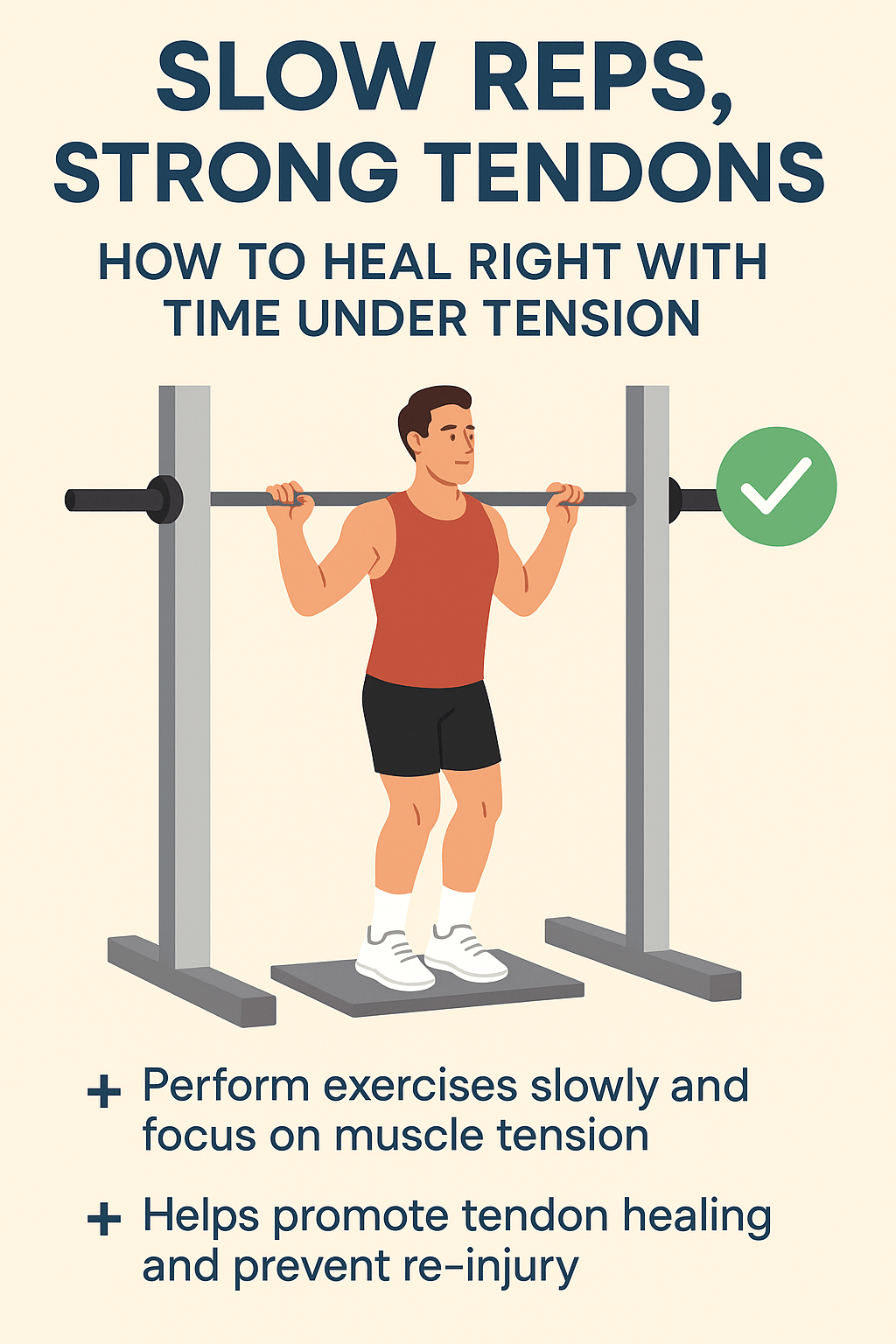
Although shockwave initiates biological change, tendons still require mechanical loading to adapt.
Shockwave provides the signal.
Loading provides the instruction.
Without loading, new collagen lacks direction.
Conversely, excessive or poorly timed loading disrupts fragile early repair.
For this reason, shockwave must act as an adjunct to loading, not a replacement for it.
Loading Principles: Why Timing Matters
Research by Magnusson & Kjaer has fundamentally shaped our understanding of tendon adaptation.
Their work shows that:
- tendon collagen turnover is slow
- collagen synthesis peaks after loading and remains elevated for up to 48–72 hours
- tendons require recovery windows to remodel
- meaningful structural adaptation occurs over months, often 6–12 months
As a result, daily high-load tendon training is rarely optimal. Instead, tendons adapt best through cycles of stimulus and recovery, not constant stress.
A Clinical Example: Why Six Months Is a Success, Not a Failure
With full, informed consent, the following anonymised case illustrates this clearly.
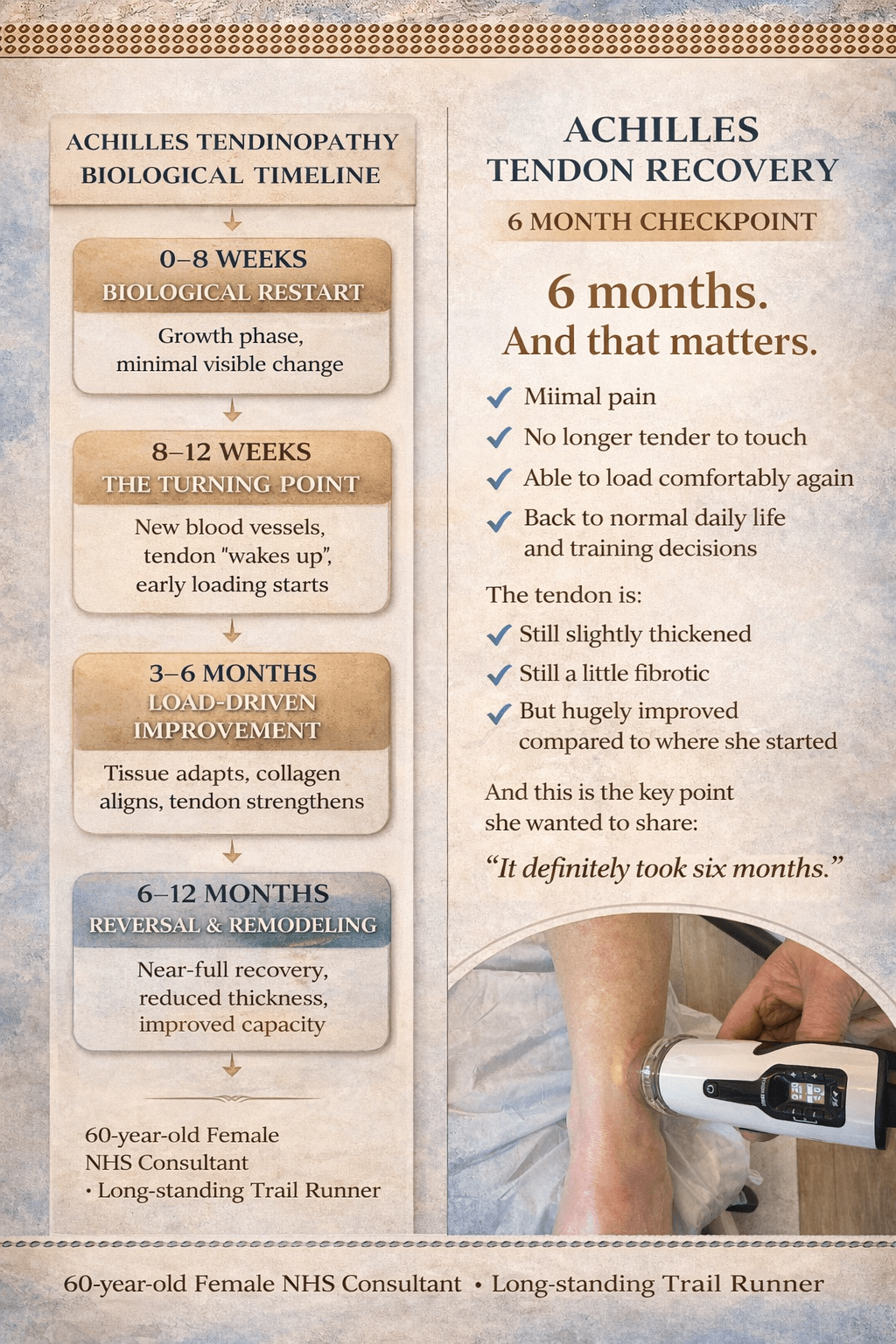
A female NHS consultant and long-term trail runner presented with chronic mid-portion Achilles tendinosis that had failed traditional rehabilitation.
Treatment combined:
- focused shockwave therapy delivered at biologically appropriate intervals
- gentle, controlled loading using BSJA-style tendon principles
- avoidance of early elastic overload
- respect for 24–48 hour recovery windows
At six months:
- pain was minimal
- the tendon was no longer tender to touch
- loading felt comfortable
- daily function had returned
Although the tendon remained slightly thickened and mildly fibrotic, this was entirely normal at this stage. Structural remodelling continues well beyond symptom resolution.
As the patient explained:
“It definitely took six months.”
Why People Lose Confidence Too Early
Many patients are told:
- “It should be better by now”
- “Shockwave didn’t work”
- “You’ve tried everything”
In reality, the tendon is often progressing exactly as biology allows — simply on a longer timeline.
Shockwave does not fail.
Loading does not fail.
What fails is understanding tendon biology.
The Principle That Ties Everything Together
Shockwave provides the biological signal.
Loading provides the mechanical instruction.
Time allows the tendon to remodel and strengthen.
When these elements align, even long-standing Achilles tendinosis can improve — not quickly, but reliably.
Final Thoughts
Achilles tendons do not respond to urgency.
They respond to precision, patience, and respect for biology.
When clinicians communicate this clearly, outcomes improve, frustration decreases, and trust is restored